
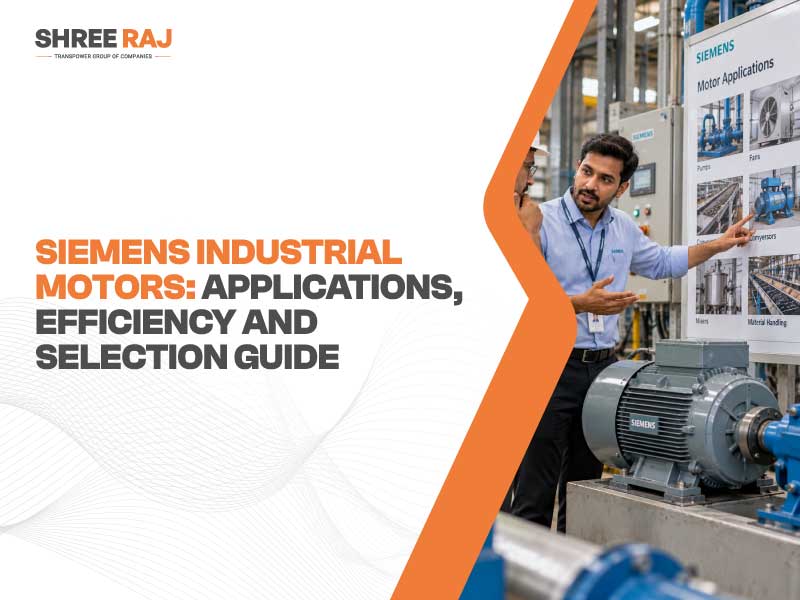
These motors by Siemens are extensively used for pumps, fans, compressors, conveyors, machine tools and other equipment in industries where dependable mechanical energy is needed. Choosing the right motor from Siemens for customers from Ahmedabad and other industrial zones of Gujarat does not mean just choosing the right HP. There are many other factors which have to be considered while choosing the motor.
Siemens industrial motor is a type of device that converts electrical energy into mechanical energy to move machines like pumps, blowers, compressors, and conveyor systems. Motors can be chosen based on the application requirements and various specifications such as power, speed, protection, efficiency, and mounting.
The range of Siemens motors that Shree Raj Traders offers includes motors with protection up to IP55, IP56 and IP65, 415 V voltage, 50/60 Hz frequency, 2/4/6/8 poles and S1/S4 duty. This range of motors has efficiencies IE2, IE3 and IE4, covering a horsepower range of 0.5 HP to 425 HP.
From an industrial buyer’s perspective, this range makes it possible to choose a motor based on machine requirements rather than having to use the same motor specifications in all applications.
The correct motor depends heavily on the driven equipment. A pump, for example, may require different operating characteristics from a conveyor or compressor.
Siemens motors are frequently chosen for centrifugal, process, and water pumps. As applications in pumps generally run for a considerable time, efficiency is an important parameter in selecting the motor.
Even a minor increase in efficiency will have a significant impact on energy consumption throughout the year as a pump that runs for 16/24 hours a day needs to be selected carefully in accordance with the pump load, hours of operation, speed, and starting requirements.
Ventilation system motors, exhaust fans, cooling systems, and process blowers need motors which are capable of working reliably for a long period of time.
The speed requirement of the motors is determined by the number of poles in the motors. In general, a 2-pole motor works faster than a 4-pole motor at the same frequency.
Compressors create heavy mechanical and electrical demands on the motor. Before purchasing the motor, it is necessary to check starting torque, duty cycle, power demand, and load conditions.
In case of critical compressors, the match of the HP of the motor alone may not be sufficient. It is essential to confirm the starting, duty, efficiency, and compatibility of the motor with the compressor.
Conveyor systems are applied in all chemical plants, warehouses, cement plants, manufacturing facilities, and materials handling facilities.
For a conveyor system motor to be efficient, it should fit in with the needed torque and speed. Sometimes, the motor will also require a gearbox or VFD for speed regulation and torque control.
Motors are also used in machine tools, processing equipment and general manufacturing machinery. In these applications, frame size, mounting arrangement, shaft dimensions, duty cycle and speed can be just as important as the motor’s rated power.
Motor efficiency is the measure of how efficiently the motor is capable of transforming electrical energy to mechanical energy. A motor with high efficiency dissipates less energy in the form of heat in the process.
There was a time when the IEC efficiency classification consisted of IE1, IE2, IE3, and IE4, starting from Standard Efficiency to Super Premium Efficiency. In IEC 60034-30-1:2025, IE5 has been added, while Siemens motors classified by Shree Raj Traders have IE2, IE3, and IE4.
Industrial motors can run for several thousands of hours in their lifecycle. It means that the cost of energy use becomes a significant part of the total cost of ownership.
For instance, Siemens states that energy-efficient motors from their company can save energy up to 10% when compared to standard-efficiency IE1 motors, depending on frame size and application. Energy savings depend on motor loading and operating time.
Therefore, a motor that runs continuously at a chemical/pharmaceutical plant should be assessed by lifecycle cost rather than just the price of purchase.
IE4 is not necessarily the right option for all replacements of industrial motors. The motor that works only for several hours per week will have a different payback period for the extra costs of purchasing.
The first error is that of selecting the motor on the basis of HP alone. Two motors with similar HP may not have similar speeds, efficiency ratings, mounting sizes, protections, and duties.
Choosing the IE3 and IE4 motors without considering the hours of operations is another mistake. It is important that any efficiency improvement be done after taking into consideration the annual operational hours and the electricity cost.
Environmental neglect can also lead to errors. For instance, a motor used in a dusty or wet area needs some form of protection while a motor used in a chemical process area may require further considerations in terms of the hazardous areas classification.
Lastly, changing a motor without checking the frame size, shaft size, and the mounting can also lead to mechanical adjustments being done at site.
In industrial buying, the supplier forms part of the buyer’s selection process. Motor specifications may include parameters like power, efficiency, size of frame, mounting, enclosures, and duty/application specifications, hence assistance during technical specification may help to avoid errors during the specification process.
Shree Raj Traders is located in Vatva, Ahmedabad and considers itself an official channel partner for Siemens and other industrial motor makers. The company has been serving the electromechanical industry for over sixty years and provides motors for various industrial applications throughout India.
The company also collaborates with other famous motor manufacturers including Crompton Greaves and Hindustan Electric Motors; thus, buyers can compare specifications according to applications and not just based on brand name comparisons.
Choosing a Siemens industrial motor is a technical choice, not just one of comparing power ratings. The power rating, 2/4/6/8 poles speed, IE2/IE3/IE4 efficiency, IP rating, S1/S4 operation, and mounting are all factors to consider that should be compatible with the application.
Shree Raj Traders can help with Siemens motor selection for industrial applications in Ahmedabad, Vatva GIDC and beyond Gujarat as per the requirements of the application. Visit the Siemens motors range or contact us to find the perfect Siemens industrial motor for you.
WhatsApp us