
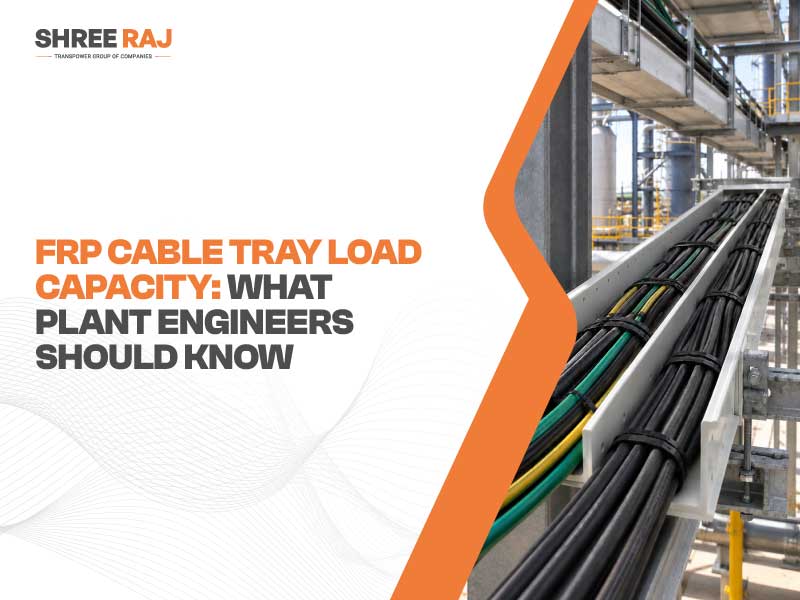
The load-bearing capacity of FRP cable tray will depend on factors like the tray design, its width, thickness, the distance between the supports, load on cables, installation and operating environment. It should always be emphasized that plant engineers should not choose an FRP tray simply by considering its dimension; rather, the whole system comprising the tray and support needs to be tested with respect to the cable load.
Load bearing capacity of FRP cable tray is the highest distributed load that can be safely carried by a cable tray system over a specified support distance without deformation or damage.
FRP refers to Fiberglass Reinforced Plastic, which is a composite that is fabricated using a combination of glass reinforcement and resin matrix. Such materials possess high strength-to-weight ratio and corrosion resistance.
The basic idea is quite clear: there is no single load bearing capacity of a tray.
Depending on the spacing between supports and the placement of cables, a 300 mm wide FRP tray may have different maximum allowable loads if spaced at 1 meter apart than when spaced at 2 meters apart.
It may be that a cable tray contains power cables, control cables, instrumentation cables or communication cables for many years. Load of cables in the beginning itself will not be the entire calculation.
The company can install additional cables when it expands its production capacity after 2 years or after 5 years. If the cable tray is selected without any consideration for future load, then the support system becomes insufficient in the future.
This is especially true in case of Vatva GIDC, Ahmedabad, where there are chemical, pharmaceutical and engineering companies whose plant layouts include several cable ways between electrical rooms, MCC, process equipments and utility areas.
The total design consideration can include more than the permanent cable weight.
Engineers should also consider:
A tray carrying 50 kg/m of evenly distributed cables is not necessarily equivalent to one carrying the same total weight concentrated heavily in one area.
It is one of the most underestimated parameters when choosing cable trays.
Let’s compare two cable trays made of FRP that are used for the same purpose. The first one is supported at 1 meter intervals, and the second one – at 2 meters intervals. In the second case, the tray has a greater unsupported span.
A larger tray does not always mean that the permitted load will increase. The tray shape, the construction of the side rails, the rung or bottom design, laminate make-up and thickness affect the performance of the tray.
Some examples include Ladder Type FRP Cable Tray and Perforated FRP Cable Tray.
Ladder trays have an open construction with rungs connecting the side members. They are useful for installations where engineers need:
They are commonly considered for larger power cable bundles and industrial cable routes.
Perforated Trays have an uninterrupted bottom that has holes that will enable cable and ventilation support.
Perforated Trays may be appropriate for light to medium cable configurations whereby there is a need for further cable support along the bottom surface of the trays.
It is not always necessary that the type of tray chosen should depend on the nature of its manufacture.
Chemical plants are different from normal commercial applications.
The cable trays could be subjected to the effects of chemical fumes, water, cleaning agents and corrosion. In such cases, corrosion resistance becomes just as crucial as mechanical loading.
This is why fiber reinforced plastic trays are chosen for industrial applications where conventional metal trays might need more corrosion protection.
In a case involving chemical plants in Vatva GIDC or Ahmedabad, the engineers need to consider two things:
Will the tray be able to bear the planned cable load for the intended support span?
Will the FRP and resin system chosen be compatible with the chemicals, temperature and humidity at the site? Selecting the tray based only on its load bearing ability would thus be incorrect.
The first error is to compare the load capability of the tray to the total weight of the cables provided by the manufacturer without verifying the testing conditions. Assume that in a given project the calculated load of the cables will be 40 kg/m.
An engineer selects an FRP tray with a load capability of 50 kg/m and thinks that the selection is done automatically.
The number 50 kg/m might have been reached at a certain support spacing and installation arrangement. With different support spacings or arrangements on this project, there may be a different load capability.
And the selection procedure should be:
Cable load → required support spacing → tray arrangement → tested load data of the manufacturer → installation verification
This approach is much more reliable than the selection based only on the tray width.
Before placing an order, prepare the basic cable-tray design information.
Calculate the Cable Load
Determine the approximate weight of all cables that will occupy each tray route.
Use actual cable datasheets wherever possible rather than estimating from cable size alone.
Define whether the project requires supports at 1 m, 1.5 m, 2 m or another spacing.
The tray’s rated performance must correspond to the selected support arrangement.
If the plant is expected to expand, include a reasonable allowance for future cables according to the project’s engineering specification.
Do not wait until the tray is full before planning the next cable route.
The tray is only one part of the installation.
Brackets, clamps, threaded rods, cantilever arms and other support components must also be capable of carrying the required load.
The supporting structure cannot be treated as an afterthought.
A 300 mm or 450 mm tray width tells you how much cable space is available. It does not, by itself, establish the allowable structural load.
This is one of the most serious selection errors. The same tray can behave differently when its support span changes.
For large power cables, the actual manufacturer’s weight per metre should be used whenever available.
A tray filled to its practical limit on day one leaves little room for additional feeders, instrumentation or control cables later.
A structurally adequate tray can still become an unsafe installation if the brackets or supporting steelwork are undersized.
FRP has excellent corrosion resistance, but temperature limits depend on the specific resin system and construction. Always check the manufacturer’s technical data for high-temperature applications.
The industrial zones in Ahmedabad have chemical plants, pharmaceutical plants, engineering industries, and manufacturing units where the environment could be quite challenging for the cable management systems.
For instance, at Vatva GIDC, there might be production areas through which cable management systems would run, where moisture and chemical resistance are important considerations in engineering terms.
Shree Raj Traders is an Ahmedabad-based supplier of FRP cable trays in various forms such as ladder and perforated styles. Being a member of the Transpower Group having more than 70 years of industry experience, the company specializes in tailoring industrial products to fit the application needs instead of every project being just another standard size purchase.
Check out the FRP Cable Tray range offered and also the guide on FRP cable tray features.
Load bearing capacity of FRP cable tray cannot be decided on the basis of width of the tray alone. Factors like cable load, support distance, construction of tray, environmental factors, and possibilities of future expansion have to be taken into account.
In case of industrial applications in Ahmedabad and Vatva GIDC, Shree Raj Traders can assist in choosing the right FRP cable tray system. Browse through the FRP cable tray product range or get in touch with Shree Raj Traders for more information.
WhatsApp us