
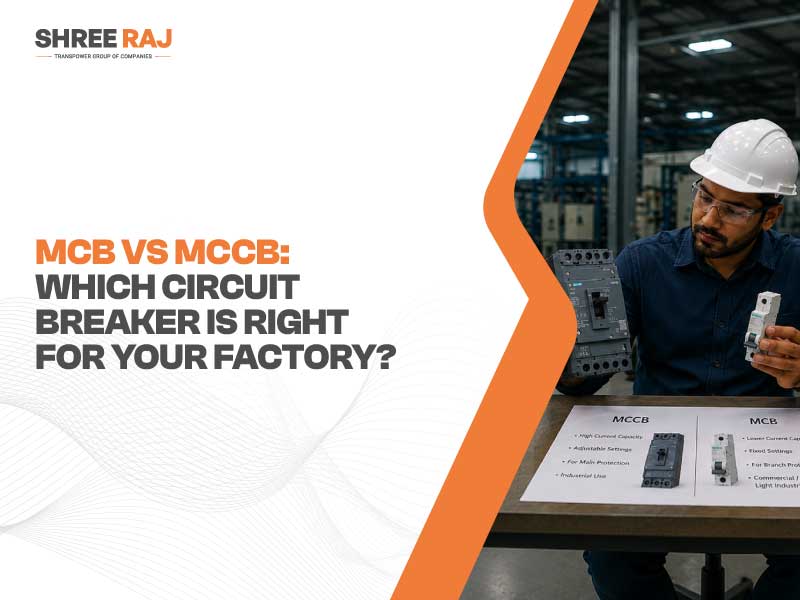
MCB can normally be considered for low-load circuits, whereas MCCB is more preferable for high load circuits in industries and motor circuits. Choice of either MCB vs MCCB would depend upon factors such as load current, fault level, breaking capacity, installation type and desired level of protection. Choice of MCB or MCCB for a factory in Ahmedabad and Vatva GIDC would have to be made on the basis of electrical design and not cost only.
The function of the MCB (Miniature Circuit Breaker) is to guard the electrical circuit from any overloading and short-circuit. The MCB is very compact and economical and is widely used in lighting, control circuits, small machines, and other such electrical circuits which have low currents.
The function of the MCCB (Moulded Case Circuit Breaker) is also the same as the MCB except that MCCBs are rated for higher currents and are thus used in bigger and more complex electrical installations.
This distinction can be seen from the size of the electrical installation.
An MCB may suffice for small electrical control panels. However, for a big factory’s main incoming switch or motor feeders, one would require an MCCB due to the increased levels of current and short circuit.
Feature | MCB | MCCB |
Full form | Miniature Circuit Breaker | Moulded Case Circuit Breaker |
Typical application | Final circuits, lighting, control circuits | Main feeders, motors, industrial distribution |
Current range | Generally lower-current applications | Designed for higher-current applications |
Breaking capacity | Suitable for lower fault levels | Available for higher fault levels |
Protection adjustment | Usually fixed | Adjustable options available depending on model |
Physical size | Compact | Larger |
Cost | Lower | Higher |
Industrial use | Small and medium circuits | Heavy-duty industrial circuits |
Installation | Distribution boards and control panels | Main LT panels, feeders and motor circuits |
The important point: an MCB is not simply a smaller version of an MCCB. The two devices are designed for different levels of electrical protection and distribution.
It is also appropriate to use MCBs when there is a relatively low current requirement in the circuit, and the fault current is within the capacity of the MCB to break.
In an example of an industrial control panel that contains different circuits for controlling the power, lighting, instruments, or auxiliaries, they can be protected by MCBs.
MCBs prove to be extremely beneficial when there are multiple individual circuits that require protection in a particular panel.
If a fault arises in one of the auxiliary circuits, the respective MCB will operate independently without affecting any of the other circuits within the same panel, making the job easy for the maintenance team.
Shree Raj Traders provides solutions in the form of Siemens MCBs like 5SL6, 5SP and QC series under its Siemens low voltage switchgear range.
The lighting circuit and small electrical loads normally need not have an MCCB with the higher current rating.
MCB offers a compact protective device while maintaining simplicity in the distribution board. For industries having many lighting, power, and control circuits, this may be a good choice.
MCCBs become increasingly relevant as the rating of current, fault level, and needs of the system become higher.
In industry plants, MCCBs are typically used for main incomers, sub-distribution circuits, motor feeders, and circuits with large electrical devices where an MCB cannot satisfy the electrical capacity or flexibility.
The major LT Distribution panel of a factory can handle more current than each final circuit.
In this case, a MCCB can give the needed protection and also the switching function while giving room for coordination of protection with the breakers on the downstream side.
This will be important during a short circuit when the aim is to interrupt the fault and minimize unnecessary outages in other parts of the factory.
A large motor will produce high starting currents and will need proper protection coordination.
In case of a small motor load, it is possible to use an MCB, but it all depends on the motor rating and type of starting and protection. In the case of large motors, it is better to use an MCCB along with proper motor protection devices.
For instance, in a plant that uses DOL starters and contactors with overload protection, it is necessary to take into account how the circuit breaker above works with the motor protection system.
One of the most ignored considerations while choosing MCB over MCCB is breaking capacity.
Breaking capacity is the maximum short-circuit current that a circuit breaker can interrupt safely at certain conditions.
For instance, when there is a possibility of short-circuit in an industrial panel, whose calculated fault current is more than the breaking capacity of the chosen MCB, then the MCB cannot be chosen irrespective of the load current.
This is because the circuit breaker should have the capability of interrupting fault currents.
This is of utmost importance in industrial zones like Vatva GIDC, where there are high transformer capacities, feeders, and machinery with high capacity.
Select an MCB when your application is to protect a low current final circuit, lighting circuit, control circuit, or small auxiliary load where the breaker has sufficient breaking capacity for that installation.
Select an MCCB when your application is to protect a high current feeder, large motor, main distribution circuit, or industrial equipment where higher breaking capacity and possibly adjustable protection may be necessary.
Another factor to consider is the position of the breaker. The two breakers may be working under similar conditions from a basic perspective, but the electrical environments in which they operate will be vastly different.
Selecting the right Siemens protection device is one of the several elements involved in procurement in case of industrial buyers at Ahmedabad. There should also be compatibility with the panel design, load characteristics, and protection principle.
Shree Raj Traders provides Siemens low voltage switchgear equipment in Ahmedabad for industrial purposes, MCB and MCCB. Shree Raj Traders caters to its customers located near Vatva GIDC Ahmedabad and other industrial regions in Gujarat.
We can help you determine the correct category of products according to the electrical requirements of the application instead of assuming that MCB and MCCB are interchangeable products.
Explore our MCB products range or Siemens switchgear products range for industrial panels.
Generally, the MCB is ideal for low current applications like final circuit and auxiliary circuits, whereas the MCCB is preferred for high current applications like feeder, motors and distribution mains. The choice depends on current rating, breaking capacity and other factors such as load characteristics.
If you need to purchase Siemens MCBs or MCCBs for an industrial control panel in Ahmedabad or Vatva GIDC, get in touch with Shree Raj Traders on +91 97267 88690.
WhatsApp us